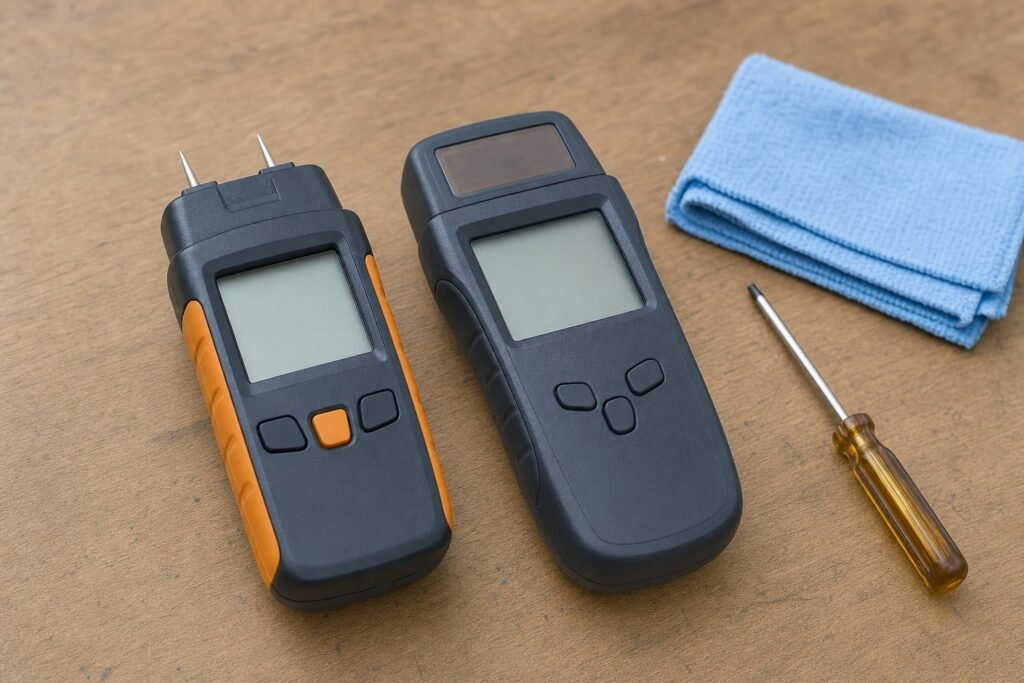
Pin vs pinless moisture meter: which reading should you trust?
A pin vs pinless moisture meter comparison is not about choosing one winner. Pin meters measure electrical resistance between two electrodes at a specific point. Pinless meters sense a broader window below the surface through capacitance. In water-damage drying, the useful reading is the one compared with the right dry material, in the right mode, at the same location over time.
Moisture measurement is the check behind a drying decision. On a wet wall, a broad scan can show where conditions change, while a point reading can help establish whether the material at that spot is returning toward normal. The two methods answer different questions, which is why general restoration practice often uses both.
The measurement and monitoring guide explains how meter readings fit with humidity and temperature data. A meter number alone is evidence, not a verdict.
How pin and pinless meters work
A pin meter drives a small electrical signal between its two pins. Wood, drywall, and other porous materials conduct that signal differently as their moisture condition changes. The meter converts the resistance it detects into a displayed result. Because the pins must contact or enter the material, the result represents the material between the electrodes and near their insertion depth.
Pinless meters do not use exposed electrodes. Their sensing plate creates an electrical field; material in that field changes the meter’s capacitance response. The displayed result represents a depth window, not a precise point. That makes a pinless meter practical for comparing a large wall or floor area without leaving pinholes, but it also means the reading can be influenced by what lies behind the face of the material.
Neither tool sees through every assembly. A metal corner bead, fastener, foil-faced insulation, dense backing, wiring, or a change in material thickness can affect a pinless scan. Pin readings can be changed by surface moisture, a poor pin contact, a shallow insertion, or measuring a different layer than the one of concern.
What each meter is good at
A pinless meter is usually the faster survey tool. It can reveal a pattern: one section of drywall reads differently from an apparently similar section nearby, or a wet-looking path continues farther than the visible stain. The operator can then mark the change and compare it with an unaffected section of the same assembly.
A pin meter is useful for targeted confirmation and repeatable point checks. It can compare two framing locations, test a known spot in a subfloor, or distinguish a damp surface layer from conditions deeper in a material when the pins can safely reach the layer being evaluated. On finished surfaces, pinholes and the risk of contacting utilities are practical limits.
For a non-wood material, some meters show a relative scale rather than a true moisture-content percentage. A relative reading is still useful when the same meter, material setting, location type, and test method are used for comparison. It tells you whether one area is behaving differently, not how much water it contains by weight.
Why material and species settings matter
Many meter displays offer moisture content for wood and a percent wood moisture equivalent, often written as %WME, for non-wood materials. Wood moisture content is a calculation based on the material’s electrical properties and a chosen wood species or species group. A framing member with one species correction may not read the same as another species at the same actual condition.
%WME is more limited than the name may suggest. It expresses how a non-wood material responds compared with wood, not a laboratory measurement of the water inside drywall, plaster, or concrete. The material scale, density, coatings, salts, and temperature can all influence it. Record the setting used so later readings mean something.
This is why a dry reference is more useful than copying an internet target. The detailed method for choosing one is covered in the dry standard guide. Compare like with like: the same material, construction, orientation, and meter mode wherever possible.
How placement and technique change the result
Repeatability begins before the meter turns on. For a pinless scan, keep the sensing plate flat to the surface and use a consistent motion. Scan a grid rather than following only the stain. Note transitions at baseboards, seams, outlets, corners, and different backing materials, because those are places where the assembly changes.
For a pin meter, place both electrodes in sound contact and keep the pin orientation and depth consistent across comparison points. Long insulated probes can help isolate a depth, while uninsulated pins average the path along their exposed length. Do not probe blindly around electrical boxes or concealed utilities. A reading that conflicts with the material layout calls for another method, not force.
A higher reading is a reason to investigate. It is not proof by itself that the entire wall cavity, floor system, or room is wet.
How to read a moisture meter during drying
First establish a baseline in an unaffected control area. Then identify the affected locations and record the meter type, setting, material, and test point. A single number has little value without that context. A sequence of comparable readings can show whether the affected material is moving toward the dry reference, holding steady, or becoming wetter again.
Look for the pattern, not a dramatic reading. A pinless map may narrow as surface and near-surface materials dry. Point readings may drop, then level off as bound water leaves more slowly. If the reading stops improving, the drying setup and the actual moisture path need review. Conditions inside the room also matter because warm air, low vapor pressure, and dehumidification support evaporation.
Meter data works best alongside a documented environmental record. See what a daily drying log tracks for the information that makes the sequence understandable.
Related questions
Can a pinless meter detect moisture behind drywall?
It can indicate a change in the material within its sensing depth, including a change that may be behind the painted face. It does not identify the exact layer or prove water is present. Backing, metal, fasteners, and density changes can create similar responses, so confirm a meaningful anomaly with a suitable comparison and other observations.
Is a higher %WME always worse?
Not by itself. %WME is a comparative electrical response, and the material, scale, meter, and test location shape the result. A higher reading than an unaffected section of the same material is more meaningful than an isolated value from an unknown setting.
Why can two meters give different readings?
They may use different sensing methods, calibrations, depths, scales, or material corrections. Even the same type of meter can differ when placed over a stud, fastener, seam, coating, or a different material layer. Consistent method and comparison points matter more than forcing agreement between unlike tools.
If you need the reading translated into a drying decision, request a moisture assessment and describe the material, visible conditions, and when the water event occurred.