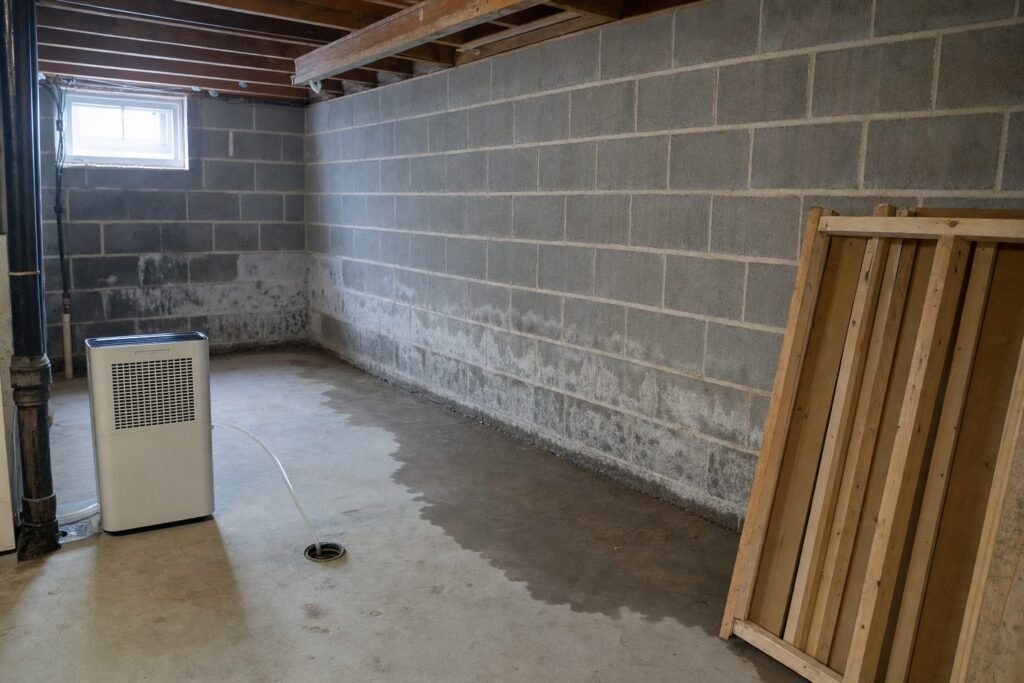
Is drying concrete basement after water possible?
Drying concrete basement after water is possible, but concrete and block release absorbed moisture more slowly than they shed visible water. Free water can be extracted quickly; residual moisture inside the slab, block cells, and mortar takes longer to migrate to the surface. The urgent question is often the finished wall, flooring, or insulation covering the concrete, because those materials can trap moisture and hide the real extent of the loss.
For drying concrete basement after water, a dry-looking floor is not the finish line. Concrete is porous, and older block foundations have both porous faces and hollow cores that can retain moisture. This page covers one of the moisture conditions in our difficult drying situations guide.
Free water and concrete moisture are not the same thing
Free water is the liquid that can be pumped, extracted, or seen on the basement floor. Once it is gone, concrete still contains moisture in its pores. That residual moisture moves gradually toward a drier surface as vapor. Air movement and dehumidification can support evaporation at the exposed face, but they cannot instantly empty a slab or block wall.
Concrete masonry block adds a second pathway. Water can enter through joints, wick through the faces, and occupy the hollow cells. White mineral deposits known as efflorescence may appear as water carries dissolved salts to the surface and evaporates. Efflorescence shows that moisture movement has occurred; it does not by itself identify whether the wall is currently wet or why water entered.
In Minnesota basements, spring thaw and exterior water management can add seasonal pressure near the foundation. The drying response inside should not be used to guess at an exterior cause. First identify whether the current moisture is from a one-time interior event, ongoing intrusion, condensation, or a combination of conditions.
When can a wet basement be dried in place?
Exposed concrete and block can commonly be dried in place after the source is addressed and free water is removed. The harder decision concerns materials installed against it: framed walls, fiberglass insulation, vapor retarders, drywall, carpet padding, laminate flooring, and finished baseboards. These layers reduce airflow to the concrete and can hold moisture against wood or paper-faced materials.
A finished basement wall can look normal because the painted drywall face is dry while its bottom edge, insulation, and plate are wet behind it. Small inspection openings or removal of base trim can reveal the wall construction and establish a measurement path. If wet materials cannot be reached and measured, preserving the finished appearance is not a reliable drying outcome.
Where a wall cavity has been wetted from the floor line, the cavity often needs targeted access rather than more room-side airflow. See drying inside wall cavities for how that decision is made.
Dry in place or remove basement finishes?
- Dry in place: concrete is exposed, wall and floor finishes are unaffected or can be accessed, and readings show improvement.
- Create openings: remove base trim or make limited inspection access where a finished wall conceals the wet lower section.
- Remove materials: porous finishes are contaminated, insulation or drywall is wet and inaccessible, wood components are swelling, or the layer cannot be verified dry.
Flooring deserves separate attention. Carpet and pad can retain water against concrete, while floating floors can hide wet underlayment. Tile may leave the slab accessible only at edges and transitions; drying under tile and stone explains the constraints of that assembly. The finish, not the concrete alone, often determines the needed access.
How does drying concrete basement after water work?
After extraction, the space is evaluated as separate layers: exposed slab or block, wall finish, framing, insulation, floor finish, and any contents that block access. The area is compared with unaffected concrete or building materials where possible. Concrete meter values need context because mix design, density, and surface conditions vary; readings are most useful as a repeatable trend, not as a single universal number.
Dehumidification lowers the moisture content of the basement air. That creates a vapor-pressure difference at exposed concrete surfaces, allowing absorbed water to migrate outward as vapor. Air movement keeps the surface boundary layer from becoming saturated, but forceful airflow against an intact finished wall does not reach the wet material behind it. Access and containment may be more important than adding more fans.
Drying a foundation often has two phases. The first targets the liquid water and wet finishes that could deteriorate quickly. The second is the slower release of moisture from concrete or block. Finished materials should not be reinstalled just because the room feels dry; the assembly needs to be evaluated against the dry condition of comparable materials and the requirements of the material being installed.
Signs moisture is still active
Fresh staining, recurring efflorescence after cleaning, damp lower wall materials, condensation, or moisture readings that rise instead of decline all justify another look at the water source and the drying environment. A dehumidifier collecting water can be normal during drying, but it does not prove that the concrete is the only source.
Do not seal, paint, or cover a basement wall merely because its face feels dry. A coating or finished wall can slow future evaporation and conceal moisture in the assembly if the underlying condition has not been evaluated.
Concrete that is structurally sound may remain while finishes around it need selective removal. The objective is not to make every block read like new material; it is to remove free water, dry vulnerable building components, and allow residual foundation moisture to decline without trapping it behind finishes.
Related questions
How long does concrete take to dry after a basement flood?
It varies with slab thickness, block construction, temperature, room humidity, how long water was present, and whether finishes cover the surface. Free water can be removed quickly, while absorbed moisture releases gradually and should be followed by condition and trend.
Does efflorescence mean a basement is wet?
Efflorescence means moisture has moved through mineral-bearing masonry and left salts behind. It is a useful clue, but it does not identify whether the wall is actively wet today or where the moisture originated.
Can drywall be dried against a concrete wall?
Sometimes, but the wall cavity, insulation, drywall bottom edge, and wood components need accessible evaluation. If those porous layers are wet and enclosed, opening the wall may be more reliable than trying to dry through the finished face.
If a basement has standing water, damp finished walls, or a persistently wet slab, request a basement moisture assessment. The next step is to identify which layers contain free water, which are slowly releasing residual moisture, and which finishes prevent verification.