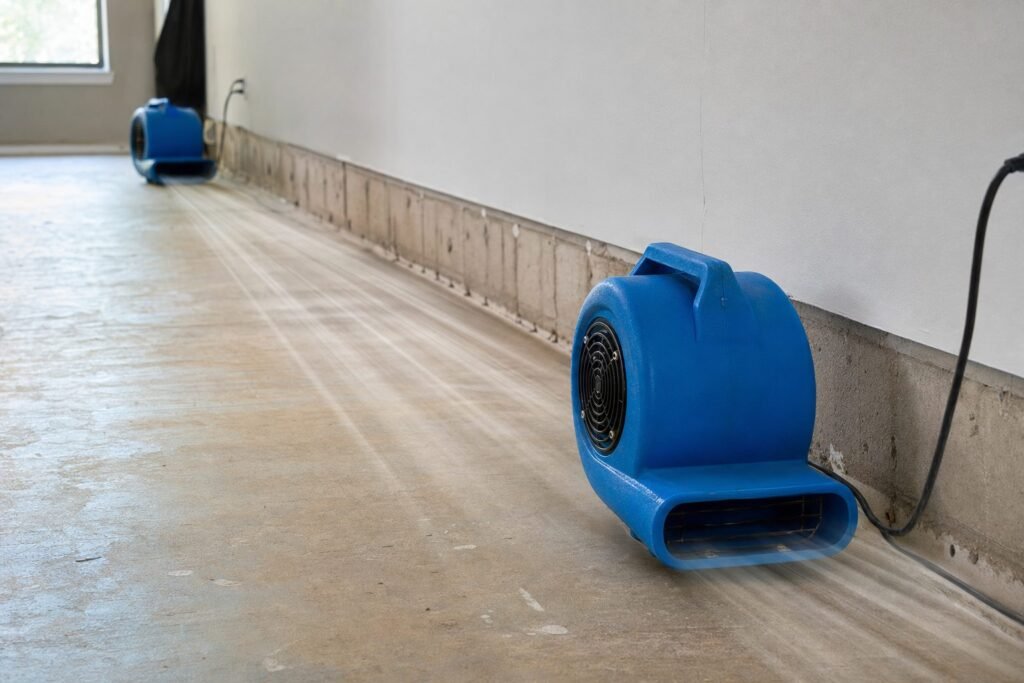
What do air movers do drying wet materials?
Air movers speed drying by pushing air across wet materials, stripping away the thin humid boundary layer that forms at the surface during evaporation. They do not remove water from the building on their own. Their value comes from correct direction, coverage, and coordination with a moisture-removal method that keeps the air dry enough to accept vapor.
An air mover is a purpose-built fan used to create fast, directed airflow close to a wet surface. In a structural drying setup, the aim is not to make the room feel windy. The aim is to keep replacing surface-level air that has become humid with air that can accept more moisture.
That narrow job fits within the larger structural drying process. Air movement acts on the evaporation side of the process; removing the newly created water vapor is a separate task.
The boundary layer is why airflow matters
As water evaporates from wood, drywall, concrete, or another wet material, the air immediately touching that material becomes humid. This thin pocket is called the boundary layer. It has a weaker vapor-pressure difference than the drier room air farther away, so it slows additional evaporation.
Directed airflow disrupts that boundary layer. It carries the humid air away from the surface and replaces it with drier air from the conditioned space. The vapor-pressure difference at the material surface becomes stronger again, which supports continued evaporation.
This is why air movers are aimed along a surface rather than placed randomly in the middle of a room. A strong blast that skips over the affected material is less useful than an airstream that sweeps its face, edges, and accessible openings.
Placement matters more than a machine count
Placement begins with the wet materials, their orientation, and the shape of the room. Air needs a path across the surface, not a short loop that bounces off furniture or runs into a wall. Equipment is commonly arranged so airflow travels around the perimeter or across a defined affected zone instead of competing head-to-head.
Low-profile units can direct air across a floor or beneath a cabinet toe kick. Other orientations can run air up a wall face or across framing. Obstructions, stairs, doorways, and room geometry change the useful path. The result should be verified by the material response, not by assuming a familiar layout fits every loss.
What air movers are good at—and what they cannot do
Air movers are effective at increasing evaporation from exposed, wet surfaces. They are especially useful when a material has a broad accessible face and when the surrounding air is being kept sufficiently dry. They can also help circulate conditioned air through an open, defined drying area.
They cannot extract vapor from the air. If enough water evaporates into a closed room without moisture removal, relative humidity rises and the vapor-pressure differential falls. Air movement can then circulate humid air without providing much drying benefit. For that half of the system, see how dehumidifiers remove moisture during water-damage drying.
Airflow also cannot force moisture through an intact, impermeable finish or solve a sealed cavity without an appropriate access or drying strategy. It does not make all materials dry at the same rate. Dense materials and bound water may release moisture slowly even when the air conditions are favorable.
Air speed, angle, and coverage
Higher air speed is not automatically better. The important point is enough movement at the material surface to break the boundary layer while keeping the air path useful. An overly forceful stream can simply leap over the surface, create uncomfortable turbulence, or scatter lightweight debris. The effective setting depends on the unit, distance, angle, and material.
Angle matters because air tends to follow a surface when directed shallowly along it. That sweep picks up humid air across a larger area. Pointing the airflow straight into a wall or floor creates a smaller impact zone and does not necessarily move air through the affected space.
Coverage is judged by the whole wet assembly. A floor may have dry-looking center boards while its perimeter, seams, or underlayment remains wetter. Placement should consider the water path, not just the most obvious wet spot.
What the equipment is telling you
The sound and air stream show that a unit is running, but neither proves drying. The useful feedback comes from material readings and air conditions over time. If materials are not trending toward their dry reference, the issue may be placement, a hidden wet layer, insufficient moisture removal, changing outdoor air, or a need for a different approach.
Air movers can make a room feel cooler through increased skin evaporation even while the space is warm. That sensation is not a moisture measurement. A psychrometric check of temperature, relative humidity, and moisture content of the air explains the actual drying potential more reliably.
What a property owner may need to accommodate
Air movers make a persistent mechanical sound and create moving air near floors and walls. Their cords and positions need to remain undisturbed so the intended pattern is not changed. Lightweight papers, loose rugs, and items near the airflow may need to be secured or moved.
Closed doors or barriers may be part of the setup. Opening a door can change the air path, while opening a window can introduce outdoor moisture that either helps or hinders drying. The equipment should be treated as a controlled layout rather than ordinary household fans.
Do not redirect or switch off an air mover because one spot feels dry. Its position may be supporting a larger airflow path, and the material condition should be confirmed before the layout changes.
Related questions
Can I use regular fans instead of air movers?
A household fan can move air, but it may not provide the direction, low-profile placement, durability, or stable airflow pattern needed for a controlled structural drying setup. The key issue remains whether air is moving across the wet material and the room air is being dried.
Why are air movers pointed at walls instead of into the room?
The target is the humid boundary layer at the wall surface. A shallow, directed airstream replaces that layer with drier air, supporting evaporation from the material rather than merely stirring the center of the room.
Do air movers make humidity worse?
They can raise the moisture content of the air because they increase evaporation. That is expected. Dehumidification must remove that vapor so the room maintains a useful drying potential instead of becoming increasingly humid.
If the airflow pattern around wet building materials needs a practical review, request an assessment of the drying setup and the area it is meant to cover.