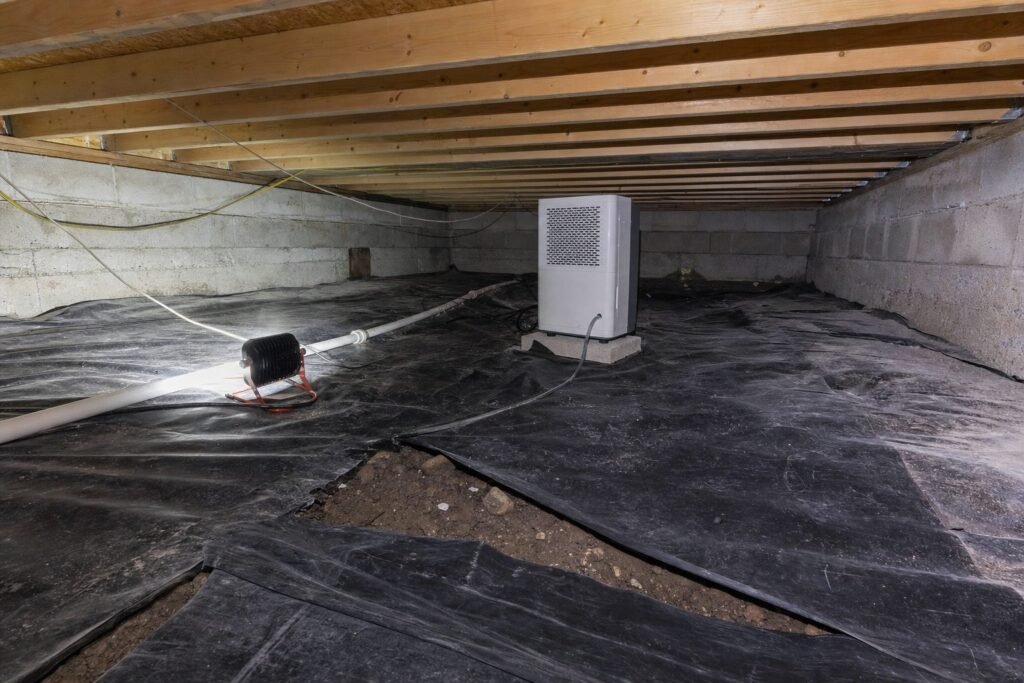
Is wet crawl space drying possible?
Wet crawl space drying is possible after standing water is removed and the ground, insulation, wood framing, and vapor barrier are evaluated separately. A crawl space cannot dry effectively while uncovered soil or a damaged vapor barrier continues adding moisture to the air. The goal is to remove the water source, create workable access, dry wet building materials, and control the ground-moisture load that remains.
Wet crawl space drying is slower than drying an open room because the space is low, dark, and connected to the earth. Water from a plumbing leak, surface drainage, or spring thaw can sit on the soil or liner, soak insulation, and raise humidity below the floor system. It belongs among the conditions covered in our difficult drying situations guide.
Why crawl spaces stay damp after the water is gone
Removing standing water solves only the free-water portion of the problem. Bare soil and wet debris continue to release vapor. A torn, incomplete, or poorly overlapped ground vapor barrier allows that vapor to enter the crawl-space air, where it can condense or be absorbed by wood, insulation, and duct surfaces when conditions allow.
In Minnesota, an unconditioned crawl space changes with the season. Spring thaw can add water around a foundation, while humid summer air introduced through vents may carry substantial moisture. Cold-season air can be dry in absolute terms, but cold surfaces and limited air movement still complicate the drying path. Opening vents or a hatch is not a drying plan by itself; the outside air must actually improve the moisture conditions inside.
Fiberglass insulation under the floor is a frequent moisture reservoir. Wet batts lose loft and can hold water against floor framing. Paper facings and accumulated debris add porous material at the lowest, least accessible part of the home. The underside of a wet wood subfloor may need a different approach than the finished floor above; see drying wet subfloor for that material-specific issue.
When can a crawl space be dried instead of rebuilt?
A crawl space can often be dried when the water source is stopped, structural wood remains sound, and the affected materials can be reached and measured. Clean water on an intact vapor barrier, with limited wetting of framing, presents a different problem from water that has mixed with soil, sewage, or long-standing organic debris.
The decision becomes more restrictive when wet insulation is compressed or dirty, wood is inaccessible behind dense insulation, or ground moisture continues to replenish the space. Porous debris and wet insulation are often removed so the framing and floor underside can be inspected and dried. That is not a judgment on whether the space looks clean; it gives moisture a route out and makes measurement possible.
What does wet crawl space drying involve?
The work sequence starts with safe access and water removal. The condition of the vapor barrier is checked: whether it covers the soil, is punctured, has water beneath it, or has shifted away from the walls. Water can pool on top of a liner, below it, or both, and each location changes what must be exposed before drying begins.
Wet insulation, debris, and other materials that block the framing are evaluated for removal. Once the wood and underside of the floor can be reached, air movement is directed across accessible wet surfaces. Dehumidification reduces the moisture content of the crawl-space air, creating a vapor-pressure difference that lets wood and other materials release moisture. In a space with exposed earth or a failing liner, the dehumidifier may be working against continuous ground moisture rather than a one-time leak.
- Control the source: correct the leak, drainage entry, or other reason water reached the space.
- Remove free water and reservoirs: address standing water, wet debris, and insulation that prevents access.
- Restore a ground barrier: evaluate whether the vapor barrier can limit moisture coming off the soil during and after drying.
- Measure the structure: compare framing and subfloor readings with unaffected material and watch the drying trend.
Equipment placement matters in a low-clearance space. Air needs a path across wet wood rather than simply spinning in one corner. Drainage for dehumidification must remain reliable, and the access opening may need temporary management so conditioned air is not immediately lost. If foundation materials are wet as well, concrete and block foundation drying explains why they continue releasing moisture after free water is gone.
Signs the crawl space needs more than drying
Repeated standing water, wet soil around the entire crawl space, a damaged vapor barrier, or insulation that stays wet are signs that a single drying cycle will not overcome the moisture load. Condensation on ducts or framing can indicate the air conditions are still wrong, although the source must be identified before drawing conclusions.
A crawl space that feels dry at the hatch can still have wet framing at the far end. Low spaces need measurements from the actual affected area, not an assumption based on air near the access door.
Wood that is visibly deteriorated, materials affected by contaminated water, and conditions that cannot be accessed safely require a broader repair decision. Drying has a clear role only when it can move moisture out of the material and verify that the remaining structure has returned toward its dry condition.
Related questions
Will opening crawl-space vents dry it out?
Sometimes outside air helps, but during humid weather it can add moisture to a cool crawl space. Ventilation has to be evaluated against actual indoor and outdoor moisture conditions rather than treated as a universal fix.
Should wet crawl-space insulation be removed?
Wet, compressed, soiled, or inaccessible insulation is commonly removed because it holds moisture against the floor system and prevents inspection. Dry, intact insulation outside the affected area may be handled differently after the water path is confirmed.
Why does the dehumidifier keep collecting water in a crawl space?
It may be removing moisture from wet framing, insulation, liner surfaces, or the soil. Continued collection does not by itself prove the structure is drying; material readings and the condition of the vapor barrier show whether the moisture source is under control.
For water below the floor system, request a crawl-space moisture assessment. The next step is to separate standing water, wet materials, and ongoing ground moisture so the drying plan addresses all three.