How to dry wet drywall without trapping moisture
How to dry wet drywall depends on how far the gypsum core has wicked water, whether the paper facing is still bonded, and what entered the wall. Firm drywall from a limited clean-water loss can sometimes dry in place. Soft, swollen, contaminated, or extensively wicked drywall is usually faster and more reliable to remove in a controlled lower-wall cut.
Drywall is a finish material, not a waterproof barrier. A visible water line can be much lower than the moisture inside the board and cavity. Start by stopping the water source and moving wet contents away; then use material readings and comparison points rather than appearance alone.
The drying-by-material guide explains why every layer needs its own dry standard. With drywall, the decision is often made early because the board can hide wet insulation and framing even after the room feels normal again.
Why gypsum drywall wicks higher than the water line
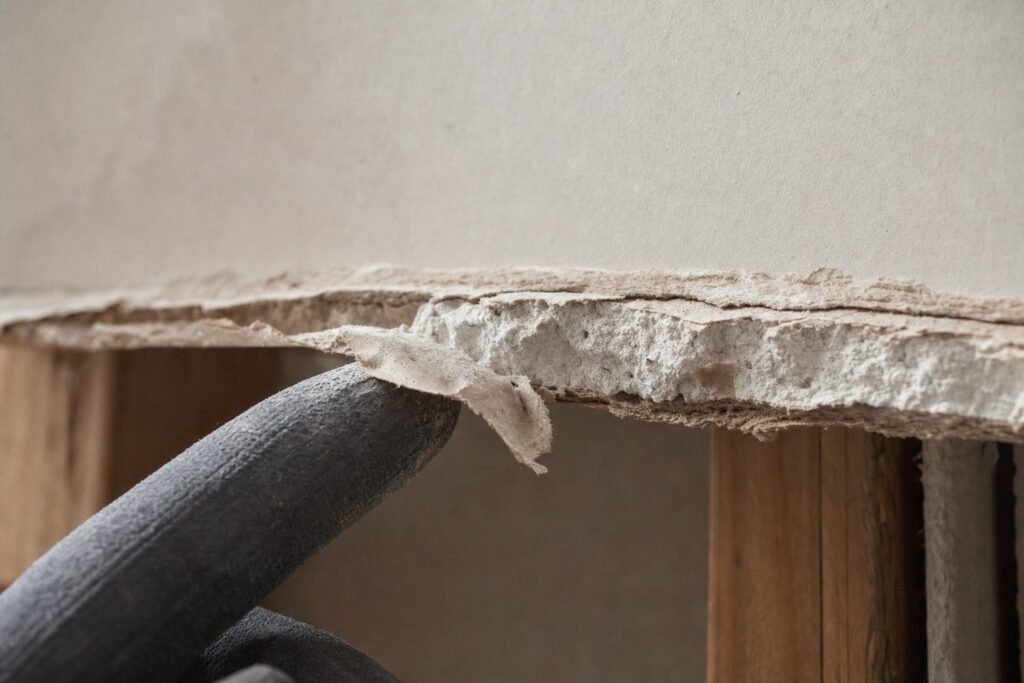
A drywall panel has a gypsum core wrapped in paper. The paper face and cut edges readily take on liquid water, while the gypsum core can pull water upward by capillary action. That is why a baseboard-level leak may leave dampness or staining well above the point where water first touched the wall.
Free water leaves first when air movement, temperature, and low-humidity air create a useful vapor-pressure difference. Water held deeper in the core moves more slowly. The paper facing complicates that exchange: it can slow evaporation on the finished side, and once adhesive or fibers fail, it may blister, loosen, or peel even if the core later loses moisture.
Joint compound, taped seams, wall texture, paint, and vinyl wallcovering can each change what can dry through the face. A meter reading should be compared with an unaffected section of the same wall construction, not treated as an isolated pass-or-fail number.
When is wet drywall still salvageable?
A limited clean-water event is the most favorable case. If the board is firm, the paper remains tight, moisture has not traveled far, and the cavity can be dried and verified, drying in place may preserve the finish. Fast source control matters because drying begins only after further wetting has stopped.
The answer changes with the category of water. Gray or black water can leave contaminants in porous materials; even a panel that looks intact may no longer be a reasonable salvage candidate. Repeated wetting, long dwell time, and a warm enclosed wall also reduce the value of trying to preserve it.
Do not use odor, a dry paint surface, or the absence of a stain as the end point. The drywall face can feel dry while the lower portion of the cavity, insulation, or wood still holds elevated moisture.
Dry in place or remove wet drywall?
The practical question is not whether any wet board can eventually lose water. It is whether drying it in place gives access to the wet assembly, preserves a sound finish, and reaches a defensible dry standard without leaving a concealed problem. When it does, targeted drying and monitoring can be sensible.
A flood cut removes a horizontal section of drywall above the affected level. It opens the wall for inspection, releases a wet paper-and-gypsum layer, and creates access to insulation and framing. For deeply saturated lower walls, it can be the faster and less wasteful route because equipment is no longer trying to push drying energy through compromised board.
Removal is more likely when the panel sags, crumbles, has swollen seams, shows broad paper delamination, or contains water from a contaminated loss. It can also be appropriate when wet cavity insulation blocks airflow. The broader drying-versus-removal decision turns on material condition, access, contamination, and the work needed to verify the result.
What does drying drywall actually involve?
After source control and an initial moisture map, drying is directed at the materials that can remain. Air movement supports evaporation at exposed surfaces, while dehumidification removes that water vapor from the air rather than allowing the room to reach saturation. Temperature is managed so evaporation continues without creating damaging extremes.
Where drywall stays in place, monitoring focuses on its moisture trend and the nearby unaffected control. Where a lower section is opened, the exposed cavity can be assessed directly. This is also when wet framing and studs deserve separate attention: lumber can remain elevated after the drywall face has recovered.
Daily checks look for a downward material trend, appropriate indoor humidity conditions, and evidence that moisture is not migrating. Equipment should be adjusted to the assembly, not left running as a substitute for measurement.
Signs drywall has passed the point of recovery
- The board feels soft, spongy, bowed, or broken at the lower edge.
- Paper is blistered, loose, visibly separated, or has released around seams.
- Edges have swollen, fasteners have distorted the face, or joint compound has cracked from movement.
- Moisture has traveled through a cavity with wet insulation or contaminated water.
- The board cannot be dried and verified without leaving inaccessible wet materials behind it.
Painting or sealing a stained wall is not a drying method. Close the wall only after the remaining materials have been evaluated against an unaffected control and the finish material is sound enough to keep.
Related questions
Can I just run fans on wet drywall?
Fans can improve evaporation at an exposed surface, but they do not remove moisture from the air or show what is happening inside the cavity. Without dehumidification and measurement, the room can become humid while moisture remains in the gypsum, insulation, and wood behind it.
Why is the drywall dry but the baseboard area still damp?
Baseboards and the lower wall collect water at edges and joints, and drywall can wick upward while water stays concentrated near the floor. Flooring materials may also be involved. If water moved across the floor, the condition of the subfloor beneath the finish may need its own evaluation.
Will drywall grow mold if it got wet?
Risk depends on the water source, material condition, temperature, and how long moisture remains available. The useful response is not to assume based on a visible spot; it is to remove unsalvageable or contaminated material and confirm that retained materials have dried appropriately.
If drywall has wicked, softened, or concealed moisture in the wall, request a moisture assessment before repairs cover the evidence.