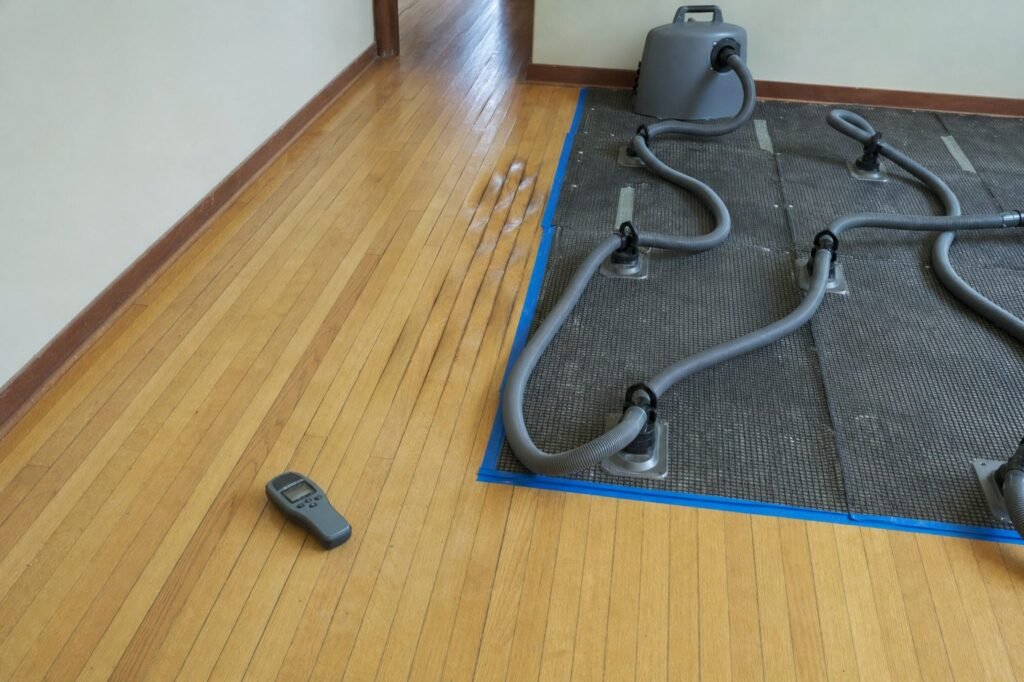
Can wet hardwood floors be saved after water damage?
Can wet hardwood floors be saved? Often, yes, if the source is stopped, the water was clean, the boards remain attached, and moisture can be removed from the flooring and its subfloor. Cupping does not automatically mean replacement. The floor needs measured drying and time to stabilize before sanding, refinishing, or removal is decided.
Hardwood is a finished surface and a moisture-sensitive wood product at the same time. It absorbs moisture through faces, edges, seams, and from the subfloor below. A room may look improved while the boards are still changing shape because their top and bottom surfaces are drying at different rates.
The drying-by-material hub explains the basic principle: the retained material controls the drying decision. Hardwood needs its own approach because preserving the finish requires attention to both the visible boards and the assembly underneath.
How hardwood takes on water and changes shape
Wood expands across the grain as it gains moisture. In a strip floor, water can enter through seams or migrate upward from a wet subfloor. The bottom of each board may become wetter than the face, causing the edges to rise relative to the center. This is cupping, and it is a moisture distribution problem before it is a cosmetic one.
Crowning is the opposite profile: the center of the board rises higher than the edges. It can occur when the face has been wetter, or when a cupped floor is sanded flat before the underside finishes drying. Once the remaining moisture balance shifts, the already-thinned edges can leave the board crowned.
Solid wood, engineered hardwood, plank width, finish type, and how the floor was fastened all matter. Engineered hardwood has a veneer over layered construction; prolonged wetting may damage those layers or adhesives in a way that differs from solid boards. There is no reliable decision based on one photograph of a bowed floor.
What is the salvage window for wet hardwood?
The best opportunity is after a limited clean-water loss that is stopped before moisture spreads through the floor assembly. Remove standing water and wet coverings, then establish the extent with readings and inspection. The longer water remains under rugs, furniture, or finish layers, the more likely boards are to stain, release, separate, or develop persistent deformation.
Water category changes the answer. Gray or black water can make a porous wood floor unsuitable to retain even if it could technically be dried. Repeated wetting, a long period of saturation, and moisture trapped over a damp subfloor also narrow the workable options.
A hardwood floor should not be rushed into a repair decision as soon as it stops looking wet. It may continue to move while internal and subfloor moisture equalize. The useful question is whether it can return to a stable, serviceable condition, not whether a fan can make the surface feel dry.
Dry in place or remove wet hardwood flooring?
Drying in place is most practical when boards are still well attached, the loss is limited, moisture can be measured, and drying can reach both the flooring and the subfloor. Access from below can be especially useful because it addresses moisture feeding the underside of the boards without immediately disturbing the finish surface.
Specialty floor drying mats can create controlled airflow or pressure over selected sections to help move moisture from the floor system. They are not a universal fix; their usefulness depends on the flooring construction, water path, seal of the setup, and whether the floor remains structurally and hygienically suitable to save.
Removal is more likely when boards buckle or detach, the finish has failed extensively, engineered layers delaminate, staining is pervasive, or contamination is involved. The drying-versus-removal framework is helpful when preservation would leave inaccessible moisture or a floor that cannot return to a stable service condition.
What does drying hardwood actually involve?
An assessment maps moisture in the boards and compares it with unaffected flooring, while also checking the subfloor and perimeter areas. Floor coverings, appliances, and furniture may hide the heaviest wetting. The goal is to see whether water entered from the top, from below, or through the board edges.
Dehumidification maintains air conditions that accept moisture, while controlled air movement supports evaporation. Drying from below may be used where the ceiling or joist bays provide access. On the finished side, floor mat systems can concentrate the effort on a wet area rather than blasting air across the entire room. Settings are monitored because wood dries best when the moisture gradient is managed rather than forced unevenly.
A wet substrate can keep feeding moisture into the boards. That is why subfloor drying is part of the hardwood decision, not a separate afterthought. The floor should be evaluated as an assembly before finish repairs begin.
When should hardwood be sanded and refinished?
Sanding is a finish repair, not a drying technique. Wait until the moisture condition has stabilized and the floor has had time to show whether cupping relaxes or defects remain. Sanding a wet or still-moving floor can remove useful wear layer, alter the board profile, and cause later crowning as the underside completes drying.
Once the floor is dry and stable, a flooring professional can evaluate whether light refinishing, board replacement, or a more extensive repair is appropriate. The decision depends on remaining board thickness, finish condition, attachment, flatness, stains, and the subfloor beneath it.
Do not sand a cupped hardwood floor just to make it look flat. Cupping describes an uneven moisture condition; sanding before that condition stabilizes can create a permanent shape problem.
Related questions
Will cupped hardwood flatten after it dries?
Some cupping can lessen as the moisture difference between the top and bottom of the boards resolves. Severe or prolonged deformation may not recover fully. The floor should be allowed to reach a stable moisture condition before appearance alone drives a repair decision.
Can I dry hardwood with ordinary fans?
Air movement can help, but it does not establish whether moisture is leaving the subfloor or whether the room air can accept more vapor. A plan for hardwood needs measurement, dehumidification, and attention to the direction water entered the assembly.
Why are boards lifting at the seams?
Expansion, compression between boards, adhesive or fastener failure, and moisture from below can all contribute. Lifting may indicate that the floor has moved beyond a simple surface drying issue. Checking the substrate helps distinguish a board-level problem from continuing moisture below.
Before sanding or replacing wet boards, request a hardwood floor moisture evaluation to establish whether the floor and its subfloor have stabilized.